PORTLAND CHORAL NOTEBOOK

  • What It Really Means to Serve on an Arts Nonprofit Board

    Over the years, I’ve experienced arts organizations from a lot of different angles, as a singer, as an administrator, and as a board member. I’ve served on the boards of Cappella Romana, as a singer representative, and Resonance Ensemble, as Managing Director. This month, I’m beginning board service with In Mulieribus, an ensemble I care deeply about.

    Stepping into this new role has made me reflect more intentionally on what board service actually means in the arts. Not the abstract version, and not the version that lives on websites, but the lived, human version of it.

    If you spend enough time in the arts world, eventually someone will ask you to serve on a board. It usually happens because you’ve been showing up in some way, attending concerts, volunteering, and advocating for an organization. It means someone believes you are thoughtful, dependable, connected in the community, or passionate enough about the organization to help guide it forward. But there is often a gap between the idea of serving on an arts nonprofit board and the lived reality of it. Arts boards quietly shape whether organizations grow, stall, fracture, or flourish

    So what does serving on an arts nonprofit board really look like?

    It’s Not Just Paperwork (and It’s Definitely Not Just Prestige)

    At its most basic level, a board exists to govern, not to run the day-to-day operations. Boards are responsible for mission, long-term health, leadership oversight, and financial stewardship.

    But good governance goes far beyond bylaws and budgets.

    Chorus America speaks about board culture as something that’s shaped, not inherited, and that boards don’t move forward by accident; they do so with intention.” I love that framing, because it reminds us that board culture doesn’t just happen. It’s shaped by how people listen, how disagreement is handled, whether curiosity is encouraged, and what ultimately guides the decisions that get made

    It’s worth saying plainly: serving on a board is not a ceremonial role. It isn’t a social club or simply attending performances with your name in a program. It is service. It asks for attention, responsibility, and a willingness to engage even when the work is largely invisible.

    What Arts Board Members Actually Do

    Every organization structures this a little differently, but most arts boards spend their time in a few core areas: stewarding mission, guiding strategy, overseeing finances, supporting fundraising, and hiring and supporting executive leadership.

    Arts Consulting Group, which works with arts organizations all over the country, often emphasizes how central board leadership is in the arts. They note that “board leadership is a core element in the success of all nonprofit organizations and perhaps more so in the unique arts and culture sector.” That line really resonates with me. Arts organizations live at the intersection of meaning and money, beauty and infrastructure. Strong boards understand that complexity and help organizations stay steady inside it.

    In other words, boards don’t exist to choose programs or tweak marketing copy. They exist to help create the conditions that allow the art to exist at all.

    What Makes Arts Boards… Arts Boards

    Arts organizations live in a funny in-between place. They are built on passion, beauty, meaning, and human connection. But, they are also built on spreadsheets, grant cycles, budgeting, and long-range planning. Arts boards are constantly navigating that space.

    What makes arts boards different from many others is that the “product” is not a service or a solution. It’s an experience. It’s something felt. It’s meaning, sound, story, and presence. That makes the work both deeply human and quietly complex.

    Arts Consulting Group and others often talk about the particular balance arts boards hold: financial sustainability alongside artistic risk, tradition alongside innovation, internal identity alongside outward relevance. Arts boards help organizations stay steady while also making room for creativity to unfold.

    What Good Board Service Feels Like

    Good board members show up. They read their materials. They ask real questions. They listen more than they talk. They support staff without crossing into staff roles. They understand that clarity doesn’t usually arrive fully formed. It often comes through conversation, questioning, and sometimes disagreement.

    They also understand that the people in the room shape the future of an organization. Who they are and what they bring to the table both matter.

    Healthy boards build cultures where people can think out loud, change their minds, and care deeply without burning out.

    Small Arts Organizations: A Different Kind of Work

    Board service may look very different depending on the size of an organization. My husband is on the board of the Oregon Symphony, and while my original thought was that their strategic plan would look much different from ours, he reminded me that the ultimate goals are basically the same: attracting audiences, supporting musicians, nurturing artistic excellence, and maintaining a secure revenue stream.

    What changes is how those goals are carried out. In a large institution, board service often lives at the level of long-range planning, major campaigns, and organizational oversight. In a small organization, those same goals are often felt much more immediately, in decisions about staffing, resources, and how to stretch limited capacity without breaking it.

    In large institutions, boards often operate at some distance from day-to-day operations. In small arts nonprofits, boards are much closer to it. Sometimes right in the middle of it.

    Arts Midwest’s writing on governance for arts organizations notes that smaller organizations often operate with what’s known as a “working board,” where board members fulfill not only governance responsibilities but also operational tasks when budgets and staff are limited, something that brings the board closer to the day-to-day life of the work.

    In small organizations, you feel the impact of decisions quickly. You see the wins. You also see the vulnerabilities. Supporting a small arts nonprofit often means helping build structures that can hold the work over time, not just in this current season of energy and devotion.

    Why People Say Yes

    The people I know who serve on arts boards don’t do it for titles. They do it because they love an art form. They love a community. They believe that something beautiful deserves their care and commitment.

    There is something quietly powerful about helping sustain work that is not easily measured. About helping artists do what they do. About contributing to spaces where people gather, listen, reflect, and connect.

    Board service can also stretch you. It teaches patience. It teaches understanding of how things connect and how decisions ripple outward. It teaches how to keep listening when the path forward isn’t obvious

    The Parts People Don’t Always Talk About

    Board service takes time. It often includes financial expectations. It sometimes includes difficult conversations. It can involve uncertainty, slow progress, and decisions where there is no perfect answer.

    Arts organizations live close to vulnerability. Funding shifts. Audiences change. Leaders move on. There are seasons of uncertainty. Boards are part of holding all of that.

    Good board members don’t disappear when things get uncomfortable. They stay curious. They stay engaged. They stay present.

    Thinking About Serving?

    If you’re considering board service, it’s worth asking yourself some gentle but honest questions:

    Do I really believe in this mission?
    Can I give this time and attention, not just affection?
    Am I willing to learn how governance works?
    Can I support leadership while also speaking up when something doesn’t sit right?
    Do I want to help build something that will outlast me?

    Often, board service begins because a current board member or staff member reaches out and asks if you would be interested. But it doesn’t always have to start that way. If there is an arts organization you truly care about, and you feel you have something meaningful to offer, it is completely appropriate to approach them and ask whether they are recruiting new board members or committee volunteers. Arts organizations are grateful when people raise their hands thoughtfully and express interest grounded in genuine care.

    A Final Thought

    Arts organizations don’t survive on applause alone. They thrive because artists create, audiences show up, communities care, and boards quietly help hold everything together. Serving on an arts nonprofit board is not about prestige or proximity to the “cool” parts of the arts world. It is about care, responsibility, advocacy, and heart.

    If you already serve on a board, thank you. If you are considering it, I hope this gives a clearer sense of what the role really means. When boards are strong, thoughtful, and committed, the entire arts ecosystem benefits.
    Selected Sources

    Chorus America. “Aligning Board Culture with the Mission and Moment.” Chorus America.

    Arts Consulting Group. “Arts and Culture Leadership: Four Action Steps to Create a Stronger Board.” Arts Consulting Group.

    Arts Midwest. “Healthy Approaches to Board Governance.” Arts Midwest.
  • If you grew up singing in the Portland metro area today, it might be hard to imagine a time when community youth choirs weren’t everywhere. But when I was in high school (1984-1988), they simply didn’t exist. School choir was the only pathway, and whether you found your way into a life-changing program depended entirely on who your teacher was. I happened to have one of the best.

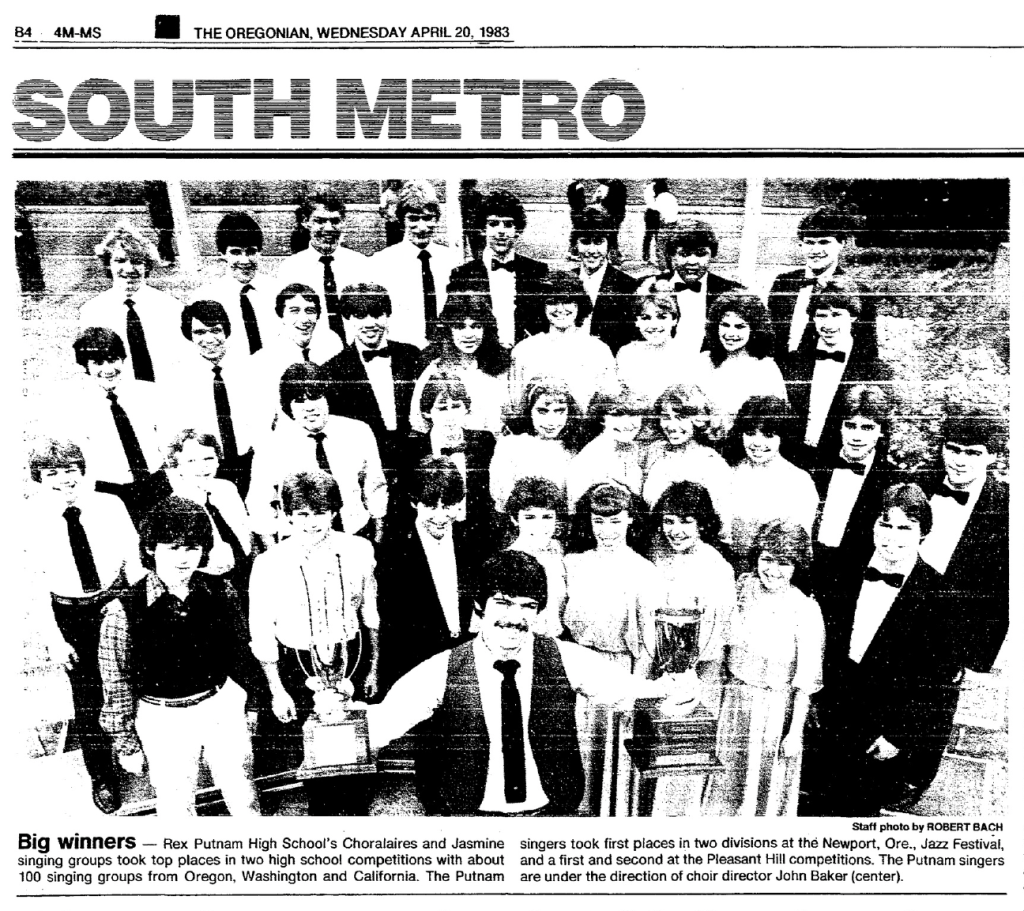
    At Rex Putnam High School, John Baker built the kind of choral program that didn’t just teach us to sing, it taught us to understand music. He was one of the first directors I knew who made sight-reading a daily part of rehearsal. We used to sight-read from old hymnals that he had received from one of the local churches and he taught us the very basics of music theory and he even created a study hall where he taught more advanced music theory to anyone who wanted to learn. For those of us without an instrumental music background, these lessons were life-changing. Looking back, I know without question that it was my ability to read music, far more than the quality of my voice, that opened the door to my professional choral career. I owe so much of that foundation to John.

    This note was written to me by John while I was at the Frank Demiero Jazz Camp in Edmonds, Washington in August 1987, the summer between my Junior and Senior years. It captures so much of who he was as a teacher, taking the time to encourage and support his students not only through his words and actions, but also in writing. I still have this note 38 years later. I know that countless young singers have been lifted up by his kindness and belief in them.

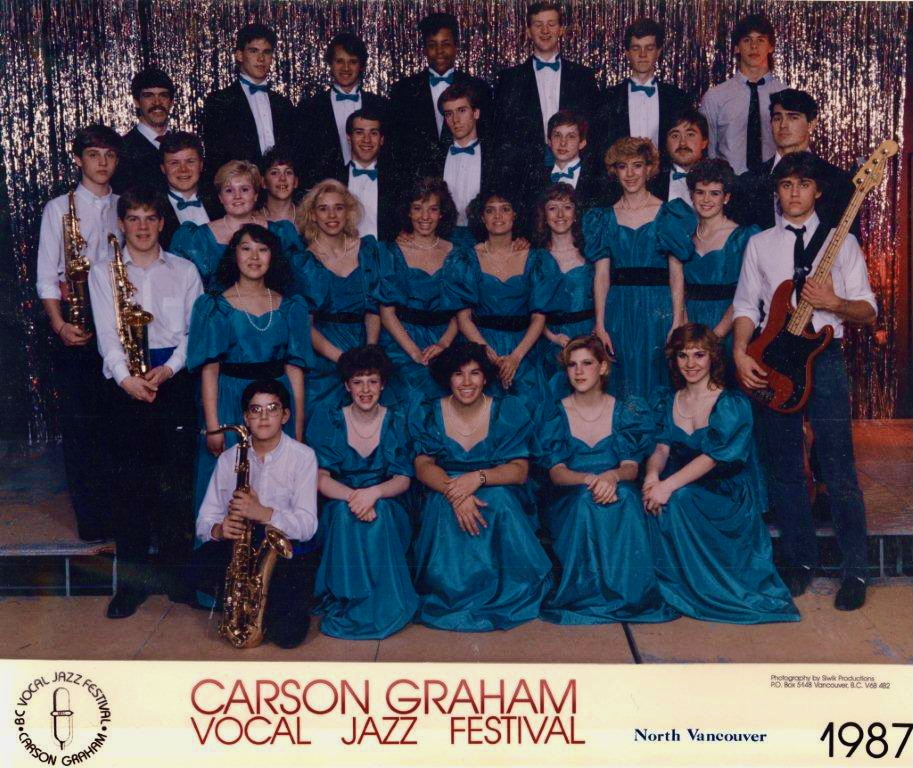
    Rex Putnam HS Choralaires 1987 (I am in the front row second from the right).

    When I asked John recently what led him into music education, he shared that it was not something he had originally planned. As a senior at Newport High School, he placed first in state in the Bass voice category. Someone important in his life encouraged him to try studying music in college, telling him, “You never know where it may take you.”

    “When I applied for music at Oregon College of Education, I was given a fifteen-page music exam. Though I excelled in choir and trombone in band, I had not learned much theory. I only managed to get my name and date correct on the exam. A college professor encouraged me to major in sports instead. I told him my goal was to see whether music might play an important role in my future. He said, ‘Don’t waste your money, you will never pass theory.’ I asked him why. He replied, ‘Because I am the music theory teacher, and there is no way you will pass.’ I asked, ‘Can you stop me?’ ‘No,’ he said. After graduation and getting hired at Rex Putnam HS, I realized music theory was very important to help singers learn to read music.  My goal was simple: teach them everything I know.  At that point in my life I knew little, so I emptied my brain in hopes they would learn.”

    His approach eventually became the topic of his master’s thesis, “Teaching Sight Reading to Choir in Daily 5 Minute Segments.” Not only did the method work for Rex Putnam, but the thesis went on to sell over 1,000 copies in the Pacific Northwest, and John was invited to present his sight-reading workshops at ACDA and MENC conventions. What we experienced in choir every day was a carefully thought-out philosophy of education that shaped hundreds of students.

    At Rex Putnam, John built a nationally respected high school program, one that combined musical excellence with an emphasis on literacy, discipline, and passion. Under his direction, Rex Putnam regularly performed at the highest competitive level, and his students developed the kind of confidence and expressiveness that inspired many of them to keep music in their lives long after graduation. Many of John’s students went on to become professionals in music careers, either singing, producing, or teaching music.

    When I asked him recently how it feels to see so many former students still singing or working in music today, his answer was beautifully simple: “Warms my heart!  For others to experience the joy and fulfillment of a music related career is wonderful. For many, music as an avocation involves less pressure and still provides the joy and adrenaline rush that makes live performances valuable.  In my case, the joy was so evident that I believe I never worked a day in my life”.

    Beyond the walls of our choir room, John’s influence stretched across Milwaukie and far beyond. When budget cuts in the early 1990s eliminated most elementary school choir programs, he refused to accept a future where children had no access to meaningful music education. Together with his wife Sandy (who also taught choir in the North Clackamas schools and happened to be my very first vocal coach in 1985), he launched what became the North Clackamas Children’s Choir and a summer choir camp, programs specifically designed to give children the opportunity to learn to read music, develop healthy singing habits, and discover the joy of choral singing long before they reached high school. What began as a modest group of about two dozen kids quickly grew into a thriving musical community, eventually serving more than a hundred young singers every year and helping sustain a choral pipeline that otherwise would have disappeared.

    Even decades into his career, John was still advocating fiercely for arts education. In a 2010 Oregonian feature connected to an OPB “Oregon Art Beat” special, he spoke candidly about how arts programs can appear strong on the surface while quietly eroding underneath due to budget pressures and shrinking participation. Today, he continues to hold both hope and concern for the future of music education. He is encouraged by teachers who “exude the knowledge, energy and enthusiasm necessary to encourage our future music makers,” and he believes there are still powerful and inspiring programs around the country. At the same time, he worries about the lingering impact of COVID, especially as even strong programs work to rebuild participation. He remains firm in his belief that committed music students excel across many areas of learning, and that music should never be the first thing cut.

    John retired from teaching at Rex Putnam in 2011, but he never stopped teaching, never stopped building community, and never stopped creating spaces where people could sing together with purpose and heart. Today, he directs the choir at Milwaukie Lutheran Church and leads the Tilikum Choir Community, where his lifelong commitment to accessible, meaningful choral singing continues. In true John Baker fashion, he has woven his past, present, and future students together, regularly inviting former Rex Putnam Choralaires to reunite and sing with the Tilikum Choir for their holiday concerts. It feels like the most fitting continuation of his life’s work: still nurturing voices, still building community, still reminding people of every age that music belongs to them.

    JOHN’S MENTORS

    Like any great teacher, John is quick to acknowledge the mentors who shaped him, recognizing how their influence helped form the teacher, musician, and leader he became.

    Richard Nace taught him the art of private voice instruction within a choral setting, and helped him understand how crucial it is to communicate meaning expressively, not only vocally, but facially as well. He also introduced John to the powerful emotional practice he called “Upsession,” opportunities for choir members to share feelings and build trust, vulnerability, and deeper connection with one another.

    Rod Eichenberger, internationally respected conductor and beloved choral figure, served for many years as clinician for Rex Putnam’s choir retreats between 1998 and 2021. From Rod, John learned that “less is more” when it comes to conducting, and that singers learn the most not when the conductor is talking, but when they are singing.

    One of John’s most profound mentors came from outside the music world altogether: legendary UCLA basketball coach John Wooden. In 1984, John came across Wooden’s book “They Call Me Coach,” and it became, in his words, a guiding text for how to treat students, how to build discipline, and how to lead with humility and fairness. Wooden’s insistence that every player—star or not—be both humble and committed deeply influenced John’s approach. He began to think of music literacy and sight reading as the “conditioning” of choral singing, just as Wooden conditioned his athletes to outlast everyone on the court. “It worked,” John said simply. He wrote to John Wooden twice over the years, and both times Wooden replied in handwritten letters, which John still treasures today.

    Looking back now, as someone who has spent decades singing professionally and building much of my adult life around choral music, I see just how deeply John Baker shaped that path. He did not simply teach us notes and rhythms. He taught discipline, curiosity, responsibility, and joy. He gave us the tools to walk into rehearsal rooms with confidence and to know that we belonged there. In every concert I’ve sung, I’ve carried his teaching with me. I will always be grateful that I was one of his students.

    Selected Sources

    Steele, Jeanette. “Summer Songs.” The Oregonian, 30 June 1994.
    Trujillo, Laura. “Dedicated to Do-Re-Mi.” The Oregonian, 22 June 1995.
    Nix, Nelle. “At Choir Camp, Everyone Gets in on the Act.” The Oregonian, 27 June 2002.
    Lawton, Wendy Y. “Singing Their Hearts Out.” The Oregonian, 3 May 2002.
    Turnquist, Kristi. “The Arts for More Than Arts’ Sake: How the Arts Helps Teach in Schools.” The Oregonian, 27 May 2010.
    Personal interview with John Baker, December 2025.

  • Anyone who knows me knows that I LOVE Christmas Music. I start listening to it in early November, because there is so much beautiful choral Christmas music out there. (I also have a big love for the crooners, Bing Crosby, Nat King Cole, Rosemary Clooney, etc.). Growing up in the Lutheran church, Christmas services were always filled with music – children’s pageants, choir anthems, carols sung by the whole congregation, and always Silent Night to end the evening (sometimes even with a German stanza). Those experiences are a big part of why I am so drawn to choral Christmas music today. It feels rooted in memory, tradition, faith, and community.

    I’ve already been to a few Advent/Christmas concerts in Portland this year… a gorgeous service of Lessons & Carols by Cantores in Ecclesia, The Trio Medieval “Yule” concert, and the joyful Oregon Repertory Singers “Glory of Christmas” concert. This weekend I’m looking forward to In Medio’s “At the Holidays” program, and In Mulieribus’ contemplative program titled “In the Stillness”.

    I am particularly excited to hear a newly commissioned version of God Rest Ye Merry, Gentlemen by Portland composer Carolyn Quick at the In Medio concert, and the title piece of the In Mulieribus program, Sally Beamish’s contemplative work In the Stillness, lovingly arranged for women’s voices by director Anna Song. Here is the original mixed choir version, sung by Voces8

    Beamish’s In the Stillness also appears on one of my all-time favorite Christmas albums, Tenebrae choir’s In Winter’s House. Their earlier album, What Sweeter Music, is another stunning, beautifully curated holiday recording that I return to often.

    Maybe it’s because of my Norwegian heritage, but two of my VERY favorite Christmas albums are the Norwegian Soloists Choir albums Rós – Songs of Christmas (2013) and Veni – Songs of Christmas (2022). I first encountered this ensemble when their conductor, Grete Pedersen, came to Portland for the 2015 National Collegiate Choral Organization conference and led a session on Norwegian folk music. Being part of that experience made hearing these albums even more meaningful.

    If I’m in the mood for something a little more exuberant, A Choral Christmas by Voces8, Voces8 Foundation Choir & Orchestra is my go-to. My husband thinks it’s a little bit too “extra” (as the kids would say). But, sometimes that kind of joyful abundance is just what my heart needs.

    I have a couple of newer albums that are in the current rotation. The first is Chanticleer’s brand new Christmas album, Joy to the World. The second is The Dawn of Grace: Music for Christmas by the Somerville College Choir, Oxford. This recording features seasonal choral works solely by female composers from the twentieth and twenty-first centuries and includes no fewer than eleven world premieres. Wow!

    I love having these albums as companions throughout the season, but one of the real joys of living in Portland is getting to hear this music live, created by the incredible musicians in our own community. It feels like such a gift to have ensembles here who approach Christmas music with thoughtfulness, artistry, and heart.

    p.s. There are still tickets available for tonight’s (12/20) In Medio performance and the In Mulieribus concert tonight (12/20) and tomorrow. (12/21) Maybe I’ll see you there!

Leave a comment

No comments on What It Really Means to Serve on an Arts Nonprofit Board